Candidate Matching Software: From Keywords to Role Fit
Candidate matching works best when it compares a person’s evidence with the outcomes and requirements of a specific role, not when it rewards keyword density.
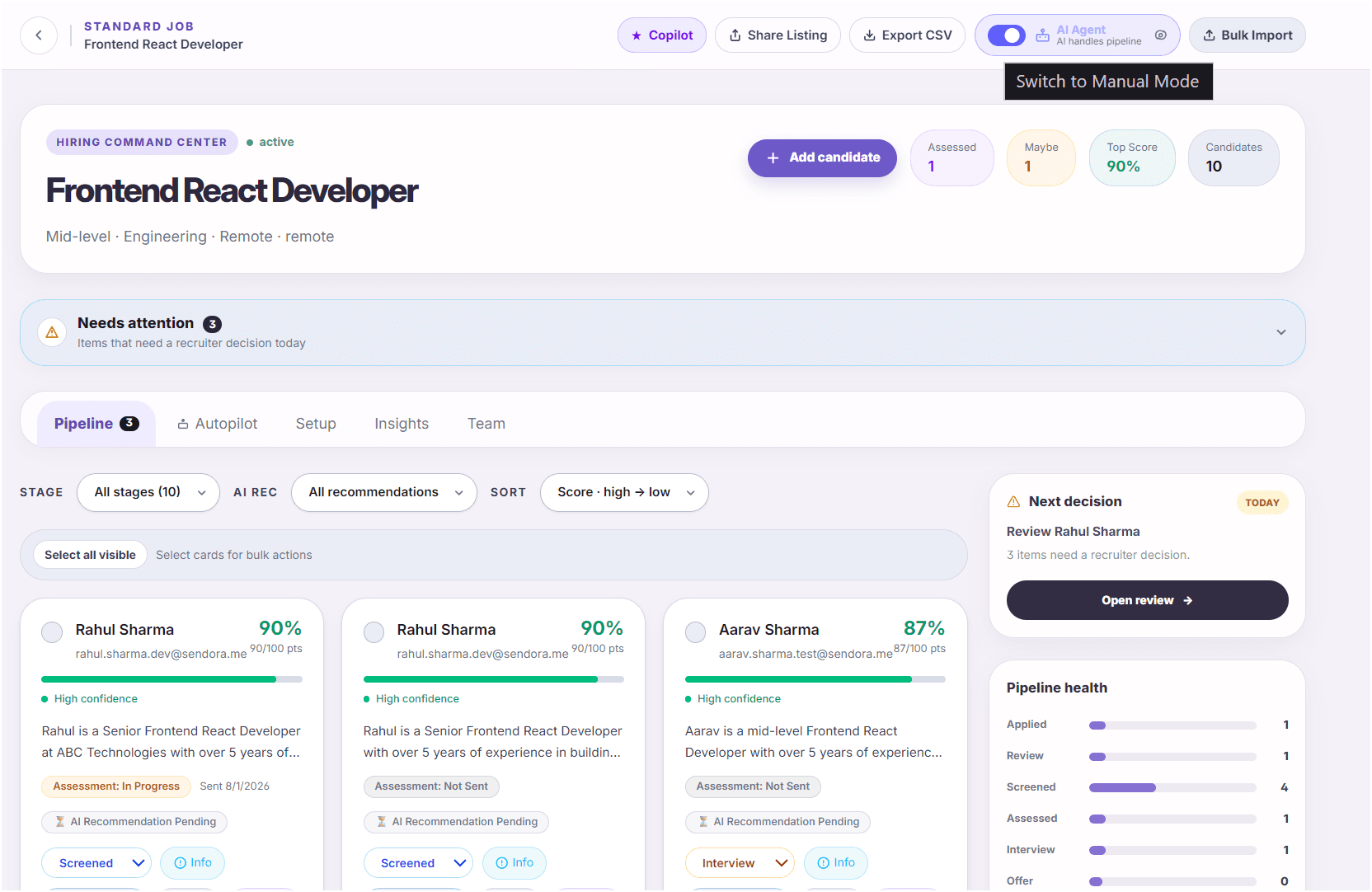
What a matching score should mean
A match score should answer a narrow question: how much of the available evidence aligns with this role’s defined needs? It is not a measure of a candidate’s worth, future potential, or fit with every team.
The score is more useful when it separates required skills, relevant experience, transferable evidence, and unknowns. Unknown is often a better label than “no” when the resume does not provide enough detail.
Design role criteria before matching
Matching quality depends more on the role brief than on the number of candidates in the database.
- Describe the work and outcomes, not just a list of tools.
- Mark which criteria are required, trainable, or preferred.
- Add a realistic seniority and location context.
- Keep the rubric short enough that reviewers can explain it.
Use matches to decide the next question
A low-confidence match may need a clarifying question, a work sample, or a second look—not an automatic rejection. A strong match still needs a conversation about motivation, communication, and the actual work.
Rolebolt combines match signals with pipeline stages, assessments, and notes so teams can turn a match into a structured next action.
Practical example
A useful match summary
For a data analyst role, a reviewer-friendly summary could separate:
- ✓Direct evidence: built recurring reports for a business team.
- ✓Transferable evidence: analyzed operational data in another domain.
- ✓Open question: depth of SQL work is not clear from the resume.
Frequently asked questions
Is a candidate match score the same as a hiring decision?
No. A match score is a decision-support signal based on available evidence for one role. It should be reviewed with the full candidate record and human judgment.
Do matching systems only search keywords?
Some systems do. Better matching considers context, outcomes, transferable skills, and role criteria, but teams should still inspect the underlying evidence.
How can recruiters explain a match score?
Use a role-specific rubric and show the evidence, unknowns, and criteria behind the score. That gives reviewers something concrete to validate or correct.
Next step
Explore AI candidate matching
See how Rolebolt connects match signals with pipeline review.
Explore AI candidate matching