Recruiting Analytics Guide: Metrics That Improve Decisions
Recruiting analytics are useful when they answer a decision question: where is the process slowing, which sources produce relevant candidates, and what should the team change next?
Start with flow metrics
Measure how candidates move through the process: time in stage, conversion between stages, response time, and the number of active candidates with a next action. These metrics reveal operational friction before a search closes.
Use a consistent date range and define each metric. “Time to hire” can mean time from approval to acceptance, while “time to fill” may start earlier.
Compare sources carefully
Source volume alone can be misleading. A smaller source may produce more relevant candidates or faster decisions.
- Applications by source and role.
- Qualified or advanced candidates by source.
- Interview and offer conversion by source.
- Time spent by the team on each source.
- Candidate experience signals and drop-off.
Turn a metric into an experiment
If candidates wait too long after an assessment, assign an owner and set a review window. If a source produces many applications but few relevant candidates, improve the job post or change the channel. Keep the next action small enough to evaluate.
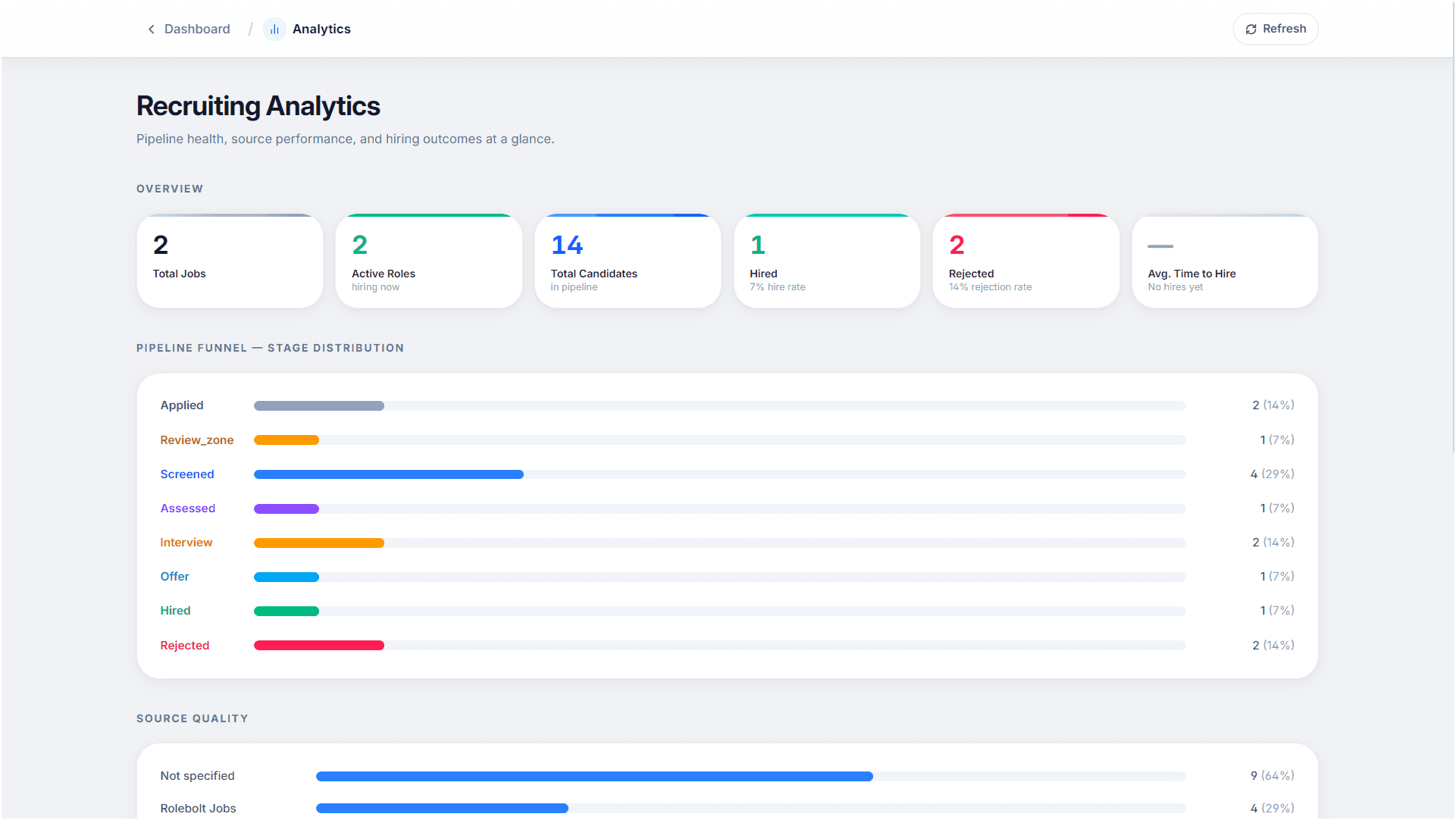
Rolebolt’s analytics surfaces bring pipeline health, stage distribution, source quality, and outcomes into the recruiting workspace.
Practical example
A useful monthly review
Ask the team to bring one metric and one action:
- ✓Metric: median days in recruiter review.
- ✓Observation: candidates wait longer on roles without a named reviewer.
- ✓Action: assign a reviewer at intake and review the change next month.
Frequently asked questions
What are the most important recruiting metrics?
Start with time in stage, stage conversion, response time, source quality, candidate drop-off, and outcomes. Choose metrics that lead to a decision.
How can recruiting analytics improve hiring?
Analytics can reveal bottlenecks, inconsistent follow-through, weak sources, and stage drop-off so teams can test focused process improvements.
Should recruiting teams optimize for speed only?
No. Speed should be balanced with quality, fairness, candidate experience, and the needs of the role. A fast process that produces poor decisions is not healthy.
Next step
Explore Rolebolt recruiting analytics
See pipeline funnel, stage distribution, source quality, and hiring outcomes.
Explore Rolebolt recruiting analytics